By Ali Syarief
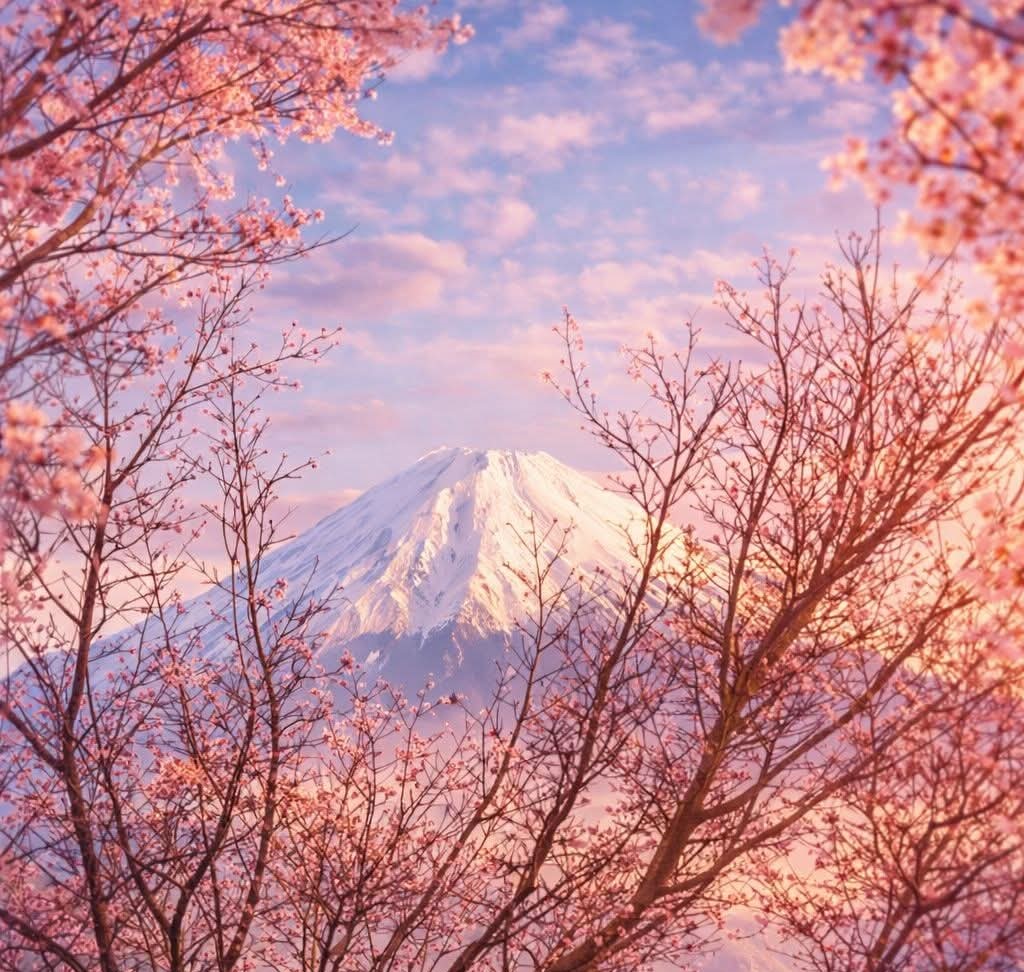
That morning, Kenshi Suzuki—my friend and, in many ways, my teacher—invited me to see Mount Fuji from a point not commonly taken. Not merely from a different physical vantage, but from a different way of seeing altogether.
He did not guide my steps as much as he guided my attention. In his presence, the act of looking became something more deliberate, almost contemplative—as if the mountain before us was not an object to be captured, but a presence to be encountered. What he offered, quietly and without instruction, was an invitation to step outside my own cultural reflexes: the instinct to frame, to possess, to conclude. Instead, he introduced me to a way of seeing that resists immediacy—a way of seeing that allows meaning to arrive slowly.
The sky that morning was unusually clear, almost too generous in its openness. Fuji stood in its most recognizable form: symmetrical, serene, seemingly eternal. It was the image that postcards promise and travelers chase. I understood, at least superficially, why generations of Japanese have revered this mountain—not just as landscape, but as presence.
“There are only two hours,” Kenshi said quietly.
At first, I thought he meant our schedule. But as time unfolded, I realized he was referring to something deeper—something about impermanence that I, shaped by a different cultural instinct, had not been trained to perceive so immediately.
Within those two hours, the clarity began to dissolve. Clouds gathered, slowly at first, then with quiet determination. The perfect outline of Fuji blurred, then disappeared behind a moving veil. Soon after, rain followed, as if to erase the certainty that had just existed.
But I had already captured it—Mount Fuji in what many would call its most beautiful form.
And yet, the photograph felt incomplete.
From a cross-cultural perspective, that moment became a subtle confrontation between two ways of understanding beauty. Coming from a background where permanence often defines value—where we seek to preserve, to hold, to document—I initially believed that capturing Fuji at its clearest was the achievement.
But Kenshi’s lesson suggested otherwise.
In the Japanese sensibility, deeply influenced by traditions such as Shinto and Buddhism, beauty is not diminished by its fleeting nature; it is, in fact, intensified by it. The brief clarity of Fuji was not valuable despite its short duration, but because of it. What I had witnessed was not just a mountain revealed, but a moment granted.
After that fleeting yet profound encounter, I began to understand that seeing Mount Fuji merely as a landscape is, in a Japanese sense, to miss its essence entirely. For the Japanese, Fuji is not simply “looked at”; it is felt, inhabited, and, in many ways, believed in.
To begin with, Fuji is a sacred presence. Rooted in the spiritual traditions of Shinto and Buddhism, the mountain is seen as a dwelling place of kami—divine spirits that inhabit elements of nature. It is not unusual, therefore, that pilgrims have, for centuries, undertaken the ascent of Fuji not as tourists, but as seekers. Climbing the mountain is an act of devotion, a form of purification, and a symbolic journey from the mundane toward the transcendent.
But beyond its spiritual gravity, Fuji also occupies a unique place in the Japanese aesthetic imagination. Its near-perfect symmetry and solitary grandeur resonate deeply with a cultural preference for harmony, balance, and restraint. In this sense, Fuji is less an object of spectacle and more an embodiment of ideal form—an unspoken standard against which beauty itself is measured.
This aesthetic reverence finds its expression in art across centuries. From the woodblock prints of Katsushika Hokusai to poetry and seasonal reflections, Fuji appears not merely as subject, but as a constant—an anchor through which changing human emotions and natural cycles are interpreted. It is telling that even when partially obscured—by mist, by rain, or by distance—Fuji remains present in the Japanese mind. Visibility is not a requirement for significance.
There is also a quiet intimacy in how the Japanese relate to Fuji. It is often referred to as Fuji-san, a naming that carries both respect and familiarity. Unlike distant monuments that inspire awe from afar, Fuji exists within the emotional geography of everyday life. It appears in schoolbooks, in folk sayings, in casual conversation. It is both extraordinary and ordinary at once.
Perhaps most importantly, Fuji reflects a distinctly Japanese relationship with impermanence. Its visibility is never guaranteed. There are days—many days—when it simply cannot be seen. And yet, this elusiveness does not diminish its importance; it deepens it. To glimpse Fuji clearly, even for a moment, is to receive a kind of quiet fortune—an encounter that cannot be demanded, only accepted.
In this way, Fuji teaches a subtle discipline of perception: to appreciate what appears, to accept what disappears, and to find meaning not in permanence, but in presence.
Kenshi did not take out his camera.
Perhaps he understood that the most faithful way to honor that morning was not through preservation, but through presence.
As the rain settled in and Fuji withdrew completely from sight, I no longer felt the urge to hold on to what had passed. Instead, there was a quiet completeness in having witnessed both its revelation and its disappearance—its form and its absence.
In the end, Mount Fuji was never simply there to be seen.
It was there to teach.
And what it offered, in those fleeting hours, was not merely beauty—but a gentle, enduring reorientation of how beauty itself might be understood.