

By Ali Syarief
When members travel to Tanjung Harapan in Central Kalimantan, Indonesia, they are not merely embarking on a wildlife tour. They are entering a living classroom where culture, nature, and humanity intersect in profound ways.
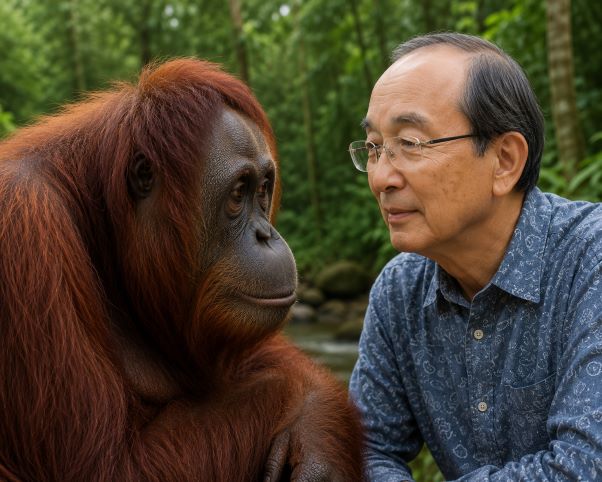
At first glance, the attraction seems obvious: observing orangutans in their natural habitat. Yet the deeper value of this journey lies far beyond wildlife observation. It is a unique opportunity for cross-cultural learning that connects Japanese participants with Indonesian village life, tropical rainforest ecology, and perhaps most importantly, with fundamental questions about what it means to be human.
Meeting Our Closest Relative
The orangutan occupies a special place in human imagination. As one of humanity’s closest living relatives, it shares approximately 97 percent of our genetic makeup. Orangutans can use tools, solve problems, nurture their young, and display emotions that appear remarkably human.
Yet despite their intelligence, orangutans have never developed language, literature, religion, governments, or civilizations. They do not tell stories about the past or dream collectively about the future.
This contrast invites an important reflection:
What truly makes us human?
For members of Hippo Family Club, whose educational philosophy emphasizes natural language acquisition and communication across cultures, the orangutan becomes more than a fascinating animal. It becomes a mirror through which we can better understand the extraordinary role of language in shaping human civilization.
The orangutan reminds us that intelligence alone does not create culture. It is language that allows humans to share experiences, transmit knowledge across generations, and build communities that extend far beyond family ties.
From Industrial Society to River Civilization
Most Japanese visitors come from one of the world’s most technologically advanced societies. They are accustomed to punctual trains, sophisticated infrastructure, and highly organized urban environments.
In Tanjung Harapan, they encounter a different rhythm of life.
Transportation depends on rivers rather than highways. Daily activities are shaped by nature rather than technology. Time moves more slowly. Relationships often matter more than schedules.
This encounter is not about comparing which society is more advanced. Rather, it demonstrates that human well-being can emerge from different social arrangements and cultural values.
Cross-cultural learning begins when we recognize that there is more than one way to organize a meaningful life.
For many visitors, this realization becomes one of the most valuable lessons of the journey.
Homestay: The Heart of Cultural Exchange
Ironically, the most transformative experience may not involve orangutans at all.
It may happen around a dinner table.
By staying with local families, participants gain access to aspects of Indonesian culture that cannot be learned from guidebooks or lectures. They experience family interactions, community values, daily routines, and local traditions firsthand.
Communication may occur through a mixture of Indonesian, Japanese, English, gestures, smiles, and shared activities. Yet this is precisely where authentic cultural exchange happens.
Hippo Family Club has long promoted the idea that language is acquired naturally through human relationships rather than through memorization alone. Homestay experiences embody this philosophy perfectly.
A host family is not merely accommodation.
It is a bridge between cultures.
Through shared meals, conversations, and daily life, strangers gradually become friends, and sometimes even family.
Learning from Nature
Japanese culture contains powerful traditions emphasizing harmony between humans and nature.
Concepts such as Satoyama—the coexistence of human communities and natural ecosystems—and Mottainai—the avoidance of waste—reflect a deep respect for the environment.
In Tanjung Puting, visitors encounter another expression of this relationship.
The rainforest, rivers, wildlife, and local communities form an interconnected system in which survival depends on balance and mutual respect.
Visitors begin to see that, despite geographical and cultural differences, Japanese and Indonesian perspectives often converge on a shared understanding:
Human beings are not separate from nature.
We are part of it.
The Orangutan as a Teacher of Humility
Modern society often places humans at the center of everything. We celebrate technological achievements and economic growth as evidence of our superiority.
The rainforest offers a different lesson.
Standing among towering trees and observing orangutans moving silently through the canopy, visitors are reminded that humanity is only one species among millions.
The forest existed long before us.
It may continue long after us.
This realization cultivates humility—a quality increasingly valuable in a world facing environmental crises and social divisions.
In the city, people often feel they control their surroundings.
In the rainforest, they discover that they are guests.
Beyond Cultural Exchange
The journey to Tanjung Harapan is ultimately more than a cultural exchange program.
It is an exploration of the relationship between humanity and nature, between modernity and tradition, between language and identity.
Participants arrive expecting to observe orangutans.
Instead, they often discover something unexpected about themselves.
They learn that culture is not merely a collection of customs. It is a way of understanding the world. They learn that communication extends beyond words. And they learn that the greatest lessons sometimes come not from classrooms or textbooks, but from forests, rivers, and ordinary families living extraordinary lives.
As members of Hippo Family Club return to Japan, they carry home more than photographs and memories. They carry a deeper appreciation for cultural diversity, environmental stewardship, and the many different ways human beings can live meaningful lives.
In this sense, Tanjung Harapan is not simply a destination.
It is a classroom without walls, where the forest teaches humanity, and where cultural exchange becomes a journey toward understanding ourselves.

