
By Ali Syarief
Orangutans Do Not Belong to Indonesia, and Bali Does Not Belong Only to the Balinese
One of humanity’s greatest misconceptions is believing that nature belongs within the borders we have drawn on maps. We say orangutans belong to Indonesia, Mount Fuji belongs to Japan, the Grand Canyon belongs to the United States, or the Serengeti belongs to Tanzania. Yet nature has never carried a passport, applied for a visa, or recognized the political boundaries created by humankind.
From a cross-cultural perspective, the Earth is our shared home. We are all temporary residents of the same planet, born by chance in different corners of the world. Its natural wonders are therefore not the exclusive property of any nation—they are the common heritage of humanity.
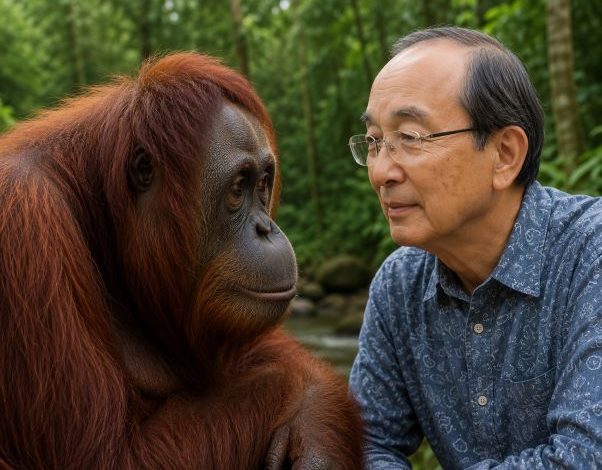
The orangutans of Borneo are a powerful reminder of this truth. These remarkable great apes have inhabited the tropical rainforests for millions of years—long before the Republic of Indonesia existed, long before the modern nation-state was conceived. To call them “Indonesia’s orangutans” is merely an administrative description because they happen to live within Indonesia’s present-day borders.
Morally and ethically, however, they belong to all humankind.
When an orangutan loses its forest to wildfire, illegal logging, or irresponsible land conversion, the loss is not Indonesia’s alone. It is a loss for every child who dreams of seeing these extraordinary creatures, for every scientist seeking to understand evolution, and for every generation that deserves to inherit a world as rich in biodiversity as the one we enjoy today.
The same is true of Bali.
Its breathtaking beaches are not meant only for the Balinese people. The emerald rice terraces of Tegalalang, the sunsets over Tanah Lot, and the island’s unique cultural landscape are gifts of nature and human creativity that inspire people from every nation, language, religion, and culture.
That is the essence of global civilization.
In Japan, there is a beautiful philosophy called ichi-go ichi-e—the belief that every encounter is unique and may never happen again. Travel embodies this wisdom. We may have only one chance in our lifetime to see wild orangutans in Borneo, to watch the sunrise over Mount Bromo, or to experience the serenity of a Balinese temple at dusk. Even if we return, the moment itself can never be repeated.
Travel, therefore, is far more than tourism. It is cross-cultural education. It teaches us humility. It reminds us that humanity is larger than nationality and that every culture offers a different way of respecting nature. The more we travel, the more we discover that diversity is not a barrier—it is humanity’s greatest strength.
Unfortunately, nationalism is sometimes misunderstood as exclusive ownership. Mature nationalism means something entirely different. It means accepting the responsibility of protecting the treasures entrusted to us so that people everywhere—and generations yet unborn—may continue to appreciate them.
Indonesia does not truly “own” the orangutans.
Indonesia has been entrusted with the responsibility of protecting them.
Likewise, Bali does not belong solely to the Balinese people. It is a precious inheritance entrusted to them to preserve, nurture, and share with the world.
The same principle applies to the Amazon rainforest, the Great Barrier Reef, the Himalayas, and Antarctica. These extraordinary places are chapters of one story—the story of our shared planet.
This is the heart of a cross-cultural worldview: seeing ourselves not merely as citizens of separate countries, but as fellow inhabitants of one Earth with a shared responsibility to protect its beauty and diversity.
And because life is finite, there is one simple lesson we should never forget.
If you are blessed with good health, the means to travel, and the opportunity to explore, visit the places that have long lived in your dreams. Meet people whose cultures differ from your own. Listen to unfamiliar languages. Stand quietly in the rainforests of Borneo and hear the distant call of an orangutan. Watch the waves roll onto the shores of Bali. Witness the wonders of our planet while they still exist.
For in the end, what defines a meaningful life is not how much wealth we accumulate, but how much of the world we have experienced, how many cultures we have embraced, and how deeply we have learned to appreciate the extraordinary gift called Earth.
We do not own this planet.
We are simply its temporary caretakers, entrusted with the privilege of protecting its wonders so that those who come after us may experience the same sense of awe.