
BY Ali Syarief
In a world increasingly shaped by economic competition, political tensions, and technological disruption, culture remains one of the most powerful bridges connecting nations. Music, in particular, possesses a universal language capable of crossing borders, dissolving differences, and building emotional understanding among people of different backgrounds. It is within this spirit that the upcoming angklung performance in Japan by the Svara Mandiri Angklung Group becomes more than merely an artistic event. It represents a living form of cultural diplomacy between Indonesia and Japan.
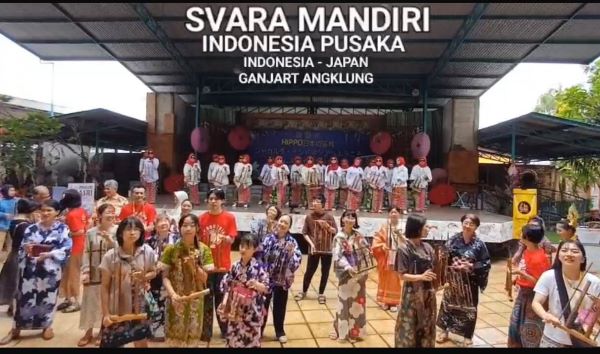
On June 7, 2026, the Cross Culture Institute, together with Japan’s LEX/Hippo Family Club, will organize an angklung performance at Tokyo Women’s Plaza Hall in Jingumae, Shibuya. The event will feature the Svara Mandiri Angklung Group, a unique ensemble consisting of mothers and women employees from Bank Mandiri. Supported by 25 angklung players and one conductor, the group will carry the sounds of Indonesia’s traditional bamboo instrument into the heart of Tokyo.
At first glance, the performance may appear to be a simple cultural presentation. Yet behind the melodies of angklung lies something much deeper: the representation of Indonesia’s identity, warmth, and communal spirit. Angklung itself is not merely a musical instrument. It symbolizes harmony, cooperation, and togetherness. Every note depends on collective participation. No single player can produce a complete melody alone. In this sense, angklung reflects the philosophical foundation of Indonesian society — mutual cooperation and social harmony.
The participation of Svara Mandiri is also remarkable because the group is composed largely of ordinary working mothers rather than professional international performers. Their presence carries an important message: cultural preservation does not belong exclusively to state institutions or elite artists. It can live within communities, families, and workplaces. These women demonstrate that cultural pride can grow naturally from everyday life.
Svara Mandiri is not new to cultural performances. The group has actively participated in various events across Indonesia, including a gathering attended by 85 Japanese cultural exchange participants at the Galery Kampoeng Baru, Duren Sawit, Jakarta, on January 1, 2026. Their consistent involvement in cultural exchange activities shows how people-to-people interaction can strengthen international friendship in ways that formal diplomacy often cannot achieve.
According to the group’s leader, Mrs. Endang, the upcoming performance in Japan marks the beginning of Svara Mandiri’s international journey. Her statement reflects not only excitement, but also hope. She believes this cultural mission can become a benchmark for other Indonesian groups aspiring to introduce local traditions to the global stage.
Indeed, Indonesia possesses extraordinary cultural wealth, yet many traditional arts remain underexposed internationally. Events like this serve as reminders that global recognition does not always require grand state-sponsored programs. Sometimes, sincere grassroots initiatives are far more powerful because they carry authenticity and emotional connection.
Japan itself has long demonstrated deep respect for cultural preservation. Traditional arts such as tea ceremonies, kabuki theater, and taiko drumming continue to flourish amid rapid modernization. In this context, the meeting between Japanese audiences and Indonesian angklung performers becomes a meaningful encounter between two Asian civilizations that equally value heritage and tradition.
More importantly, this performance illustrates how cultural exchange can build mutual understanding beyond politics and economics. Governments may negotiate agreements, but culture touches the human heart directly. Through music, audiences do not merely observe another country — they feel it.
The journey of Svara Mandiri to Japan therefore, carries symbolic significance. It is not simply about performing angklung abroad. It is about bringing Indonesia’s soul, hospitality, and collective spirit to an international audience. It is about proving that diplomacy can emerge not only from presidential palaces or conference halls, but also from the gentle rhythm of bamboo instruments played by dedicated mothers carrying the pride of their nation.
In the end, the sound of angklung in Tokyo will echo something greater than music itself. It will echo friendship, cultural respect, and the enduring belief that harmony among nations can still be built through art and humanity.