A Lesson in Gratitude from a Single Grain of Rice
By Ali Syarief
During my many homestays with Japanese families over the past two decades, I discovered that some of the most profound lessons about Japan were not learned in classrooms, museums, or temples. They were learned around the dining table.
The meals were always simple.
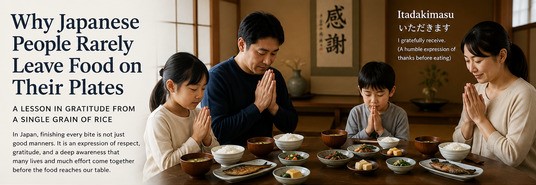
A bowl of steamed rice, miso soup, grilled fish, seasonal vegetables, and a few pickles. Nothing extravagant. Nothing excessive.
Yet one detail quietly captured my attention.
When the meal was over, every plate was clean.
Every bowl was empty.
Even the last grain of rice was carefully picked up with chopsticks.
At first, I assumed this was merely good table manners.
Later, I realized it reflected something much deeper.
For the Japanese, finishing one’s meal is not simply about etiquette.
It is about respecting life.
Before eating, people say Itadakimasu.
After finishing, they say Gochisōsama deshita.
These two simple expressions frame an entire philosophy of life.
Itadakimasu does not literally mean “Let’s eat.”
It expresses humble gratitude: “I gratefully receive.”
What is being received is not merely food.
It is life itself.
The rice represents months of a farmer’s labor.
The fish surrendered its life so another life could continue.
The vegetables grew through the combined gifts of sunlight, rain, fertile soil, changing seasons, and countless unseen hands.
Every meal tells a story of interdependence.
To waste food is to forget that story.
One day, I asked my Japanese friend, K. Suzuki, a question that had been on my mind.
“Why are Japanese children so careful about finishing their meals?”
He smiled before giving an answer I have never forgotten.
“Because from the time we are little,” he said, “we are taught that this is what the Emperor does.”
His answer surprised me.
Suzuki explained that Japanese children are educated not only through rules but also through examples. Respect for food is presented as a virtue embodied by those worthy of admiration. The lesson is simple yet powerful: if the Emperor shows gratitude by never treating food carelessly, then ordinary people should strive to do the same.
Whether in schools or at home, children are encouraged to see finishing their meals not as an obligation, but as an expression of appreciation.
That brief conversation changed my understanding.
The character of a nation is not shaped only by laws or speeches.
It is shaped by the examples its people choose to follow.
As I spent more time in Japan, I came to understand that this attitude toward food is rooted in a broader philosophy known as Shindo Funi (身土不二)—literally, “body and land are inseparable.”
The idea is beautifully simple.
Human beings are part of the land on which they live.
The healthiest food is that which grows naturally in one’s own climate, season, and environment.
Long before modern nutrition or sustainability became global concerns, the Japanese had already embraced a worldview in which humans and nature exist in harmony rather than in competition.
Food, therefore, is never just a product.
It is a gift from nature.
It is also a gift from those who cultivate the land, harvest the sea, transport the ingredients, prepare the meal, and share it with others.
This understanding transforms eating into an act of gratitude.
I was reminded of this every morning when I saw elderly Japanese families offering tea and seasonal foods at the family altar before eating them. These offerings were not made because their ancestors needed food, but because the living wished to express gratitude for the life they had inherited.
A meal became an act of remembrance.
An acknowledgment that our lives are connected to those who came before us.
Indonesia, too, possesses rich traditions of giving thanks before meals, celebrating harvests, and honoring nature’s abundance.
Yet modern life often encourages us to consume without reflection.
Food has become a commodity.
Restaurants compete by serving oversized portions.
Celebrations are measured by abundance rather than appreciation.
Perfectly good food ends up in the trash while millions of people around the world still go hungry.
Japan offers a quiet but powerful alternative.
Take only what you need.
Finish what you take.
Be grateful for what you receive.
These are not merely dining rules.
They are moral lessons repeated every single day.
Perhaps this is why Japan’s remarkable achievements cannot be explained by technology, economic strength, or educational excellence alone.
Behind its modern society lies something less visible but equally important: a culture that teaches gratitude through ordinary daily rituals.
Saying Itadakimasu.
Respecting farmers.
Honoring nature.
Avoiding waste.
Finishing every grain of rice.
These habits may appear insignificant.
Yet civilizations are rarely built upon grand ideas alone.
More often, they are built upon small acts of respect, practiced faithfully over generations.
That is why I have come to believe that the greatness of a civilization is not measured only by its skyscrapers, high-speed trains, or technological innovations.
Sometimes, it can be seen in something far simpler—
an empty plate,
not because there was no food,
but because nothing—not even a single grain of gratitude—was left behind.