By Ali Syarief
Over the past two decades, I have had the privilege of participating in countless cultural exchange programs between Indonesia and Japan. Through homestays, language immersion, and friendships that transcend national borders, I have come to realize that Japan’s greatest strength is not its advanced technology, economic power, or remarkable discipline.
Its true strength lies in a philosophy.
A philosophy that quietly shapes everyday life.
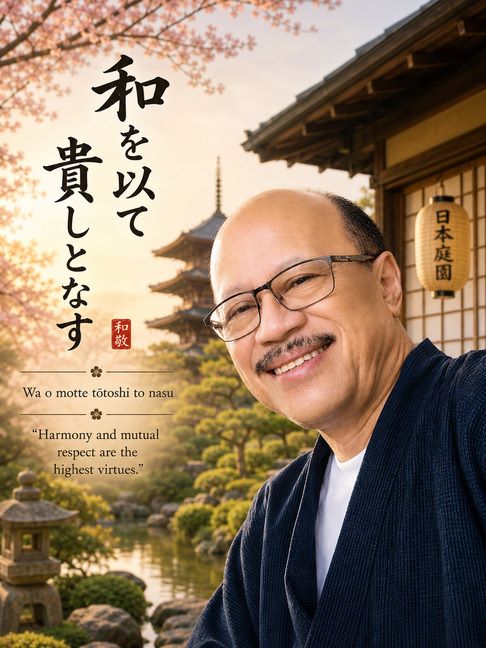
和を以て貴しとなす
Wa o Motte Tōtoshi to Nasu.
“Harmony and mutual respect are the highest virtues.”
This ancient principle, first articulated by Prince Shōtoku in the seventh century, has become one of the ethical foundations of Japanese society. More than a historical quotation, it remains a living value that continues to influence how people interact with one another today.
For many people outside Japan, harmony simply means avoiding conflict. In Japan, however, harmony goes much deeper. It means consciously placing the well-being of the group above one’s personal ego.
Respect is not reserved for people who are older, richer, or more powerful.
Respect is offered because every human being possesses dignity.
This philosophy explains many everyday behaviors that visitors immediately notice: bowing when greeting others, speaking softly on public transportation, standing patiently in line, apologizing sincerely, and always being mindful not to inconvenience those around them.
These are not merely social customs.
They are the language of respect.
Coming from Indonesia, I often observe a fascinating cultural contrast. Indonesians are generally warm, expressive, and spontaneous. We value openness, friendliness, and emotional connection. Saying exactly what we think is often regarded as honesty.
Japanese communication follows a different path.
Rather than emphasizing self-expression, it emphasizes empathy. Rather than asking, “What do I want to say?”, it often begins with another question:
“How will my words affect the other person?”
Neither approach is superior.
They simply reflect different cultural priorities.
This is precisely why cross-cultural learning is so valuable.
The goal of cultural exchange is not to become Japanese, nor to persuade Japanese people to become Indonesian.
Its purpose is to expand our perspective.
When we begin to understand why another culture thinks, behaves, and communicates differently, judgment gradually gives way to understanding.
Differences become opportunities rather than obstacles.
Throughout my years organizing exchange programs, I have often reminded participants that learning another language is only the beginning.
The deeper lesson is learning another way of seeing humanity.
Every shared meal, every conversation, every host family experience, and every act of kindness becomes an invitation to discover values that cannot be found in textbooks.
In a world increasingly divided by ideology, politics, and identity, the wisdom of Wa o Motte Tōtoshi to Nasu feels more relevant than ever.
Harmony does not require uniformity.
Respect does not demand agreement.
Peace is not created because everyone thinks alike.
It is created because people choose to value one another despite their differences.
Perhaps this is the greatest lesson cultural exchange can offer us.
We travel to discover other countries.
Yet along the way, we often discover a better version of ourselves.
Because in the end, respecting others is not merely good etiquette.
It is a reflection of our own character.
And harmony is not the absence of differences.
It is the art of living beautifully with them.