By Ali Syarief
Throughout my many visits to Japan, one aspect of Japanese society has consistently fascinated me. Surprisingly, it is neither the legendary punctuality of its trains nor its cutting-edge technology. Instead, it is the way Japanese people relate to food.
In many parts of the world, including my own country, Indonesia, food is often regarded primarily as fuel. We eat because we are hungry. The most common question before mealtime is simple: “What shall we eat today?”
In Japan, however, I discovered that the more important question is not merely what people eat, but how they honor the food before them.
This seemingly subtle difference reveals a profound cultural philosophy.
From a cross-cultural perspective, food is far more than nutrition. It is a reflection of how a society understands its relationship with nature, with other people, and with life itself.
For the Japanese, every meal tells a story.
It begins with the farmer who nurtured the rice, the fisherman who ventured into the sea, the changing seasons that produced fresh ingredients, and the chef who transformed them into a harmonious meal. Every stage of this journey deserves recognition and respect.
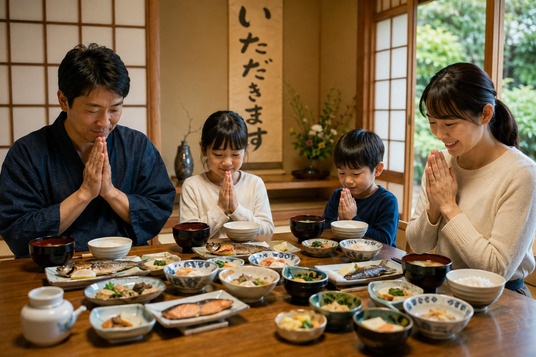
Before eating, Japanese people say Itadakimasu.
The phrase is often translated simply as “I humbly receive.” Yet its cultural meaning extends far beyond good manners. It expresses gratitude to nature, appreciation for everyone whose labor made the meal possible, and respect for the lives—plant and animal—that have become part of one’s own life.
When the meal is finished, they say Gochisousama deshita—”Thank you for the feast.”
Again, this is not merely etiquette. It is a conscious acknowledgment that no meal comes without the effort of countless individuals and the generosity of the natural world.
These simple expressions illustrate a remarkable cultural principle: eating is not merely a biological act, but a moral one.
In contrast, many modern societies increasingly treat food as a commodity. Speed, convenience, affordability, and abundance often become the dominant values. Meals are consumed quickly, sometimes while working, driving, or staring at a screen. The emotional connection between people, food, and nature gradually weakens.
As a consequence, food waste becomes commonplace.
Japan offers a different perspective through the concept of mottainai—a deep sense of regret over wasting anything that still possesses value. This philosophy applies not only to food, but also to time, resources, energy, and opportunities.
Interestingly, Indonesia possesses similar traditional values.
Many Indonesians grew up hearing their parents remind them never to waste rice because it is a blessing. In Islamic tradition, food is regarded as rizq—a gift from God—and wasting it is considered an act of ingratitude.
The underlying philosophies are remarkably similar.
The difference lies not in the values themselves, but in how consistently they are practiced.
In Japan, respect for food is embedded in everyday behavior. Portions are carefully planned. Presentation reflects balance and harmony. Children learn from an early age to finish what is served to them. Even the arrangement of dishes, colors, and seasonal ingredients is considered part of the dining experience.
The Japanese often say that people first eat with their eyes, then with their hearts, and only afterward with their mouths.
In many other cultures, however, food often symbolizes generosity or social status. Tables overflow with dishes, yet significant portions are left untouched and eventually discarded. Ironically, abundance can become synonymous with waste.
This is precisely why cross-cultural learning is so valuable.
It teaches us that ordinary activities often carry extraordinary meanings. Something as universal as eating can reveal a society’s deepest beliefs about gratitude, responsibility, humility, and coexistence.
Food, then, is not merely about calories or nutrition.
It is a cultural language.
It reflects how people relate to nature, how they value the work of others, and how they educate future generations about gratitude and responsibility.
The more time I spend in Japan, the more I realize that what the Japanese preserve is not simply a culinary tradition, but a philosophy of living.
They teach us that every grain of rice has a story.
Every bowl of soup carries a journey.
Every meal represents the efforts of countless hands.
And every time we sit down to eat, we are receiving one of life’s greatest gifts.
Perhaps this is the most profound lesson that Japan offers the world.
To eat is not simply to nourish the body.
It is to honor life itself.